
Anchor text is the clickable text in a hyperlink that guides users to another page. At first glance, it might seem simple—just a phrase that people click—but in SEO, anchor text plays a much bigger role. Search engines rely on it to understand what the linked page is about. This means the words you choose as anchor text can influence your search rankings, the credibility of your site, and the overall user experience.
Think of anchor text like a label on a file folder. If the label accurately describes the content inside, finding the right information is easy. But if the label is misleading or repetitive, it can create confusion. Similarly, using anchor text effectively in SEO signals relevance to search engines while helping users navigate your website naturally.
In this article, we will explore the types of anchor text in SEO, discuss how each type works, when to use them, and how to avoid common mistakes. By the end, you will have a clear understanding of how to create a strong, balanced, and natural anchor text strategy.
Why Anchor Text Matters?
Anchor text is more than just clickable words. It’s a way to communicate context to search engines and users alike. Imagine multiple websites linking to your content with the same anchor text, such as “Types of Anchor Text in SEO.” Google interprets this as a strong signal that your page is highly relevant to that topic.
However, using the same keyword repeatedly can look manipulative. Over-optimization is a common reason websites receive penalties. That’s why understanding the different types of anchor text in SEO and using them wisely is essential. A well-rounded backlink profile, with a variety of anchor texts, appears natural and is much safer from algorithmic penalties.
Anchor text also affects user experience. Clear, descriptive anchors guide visitors to relevant content, reducing bounce rates and increasing engagement. When used strategically, anchor text can improve SEO while making your website more user-friendly.
Exact Match Anchors
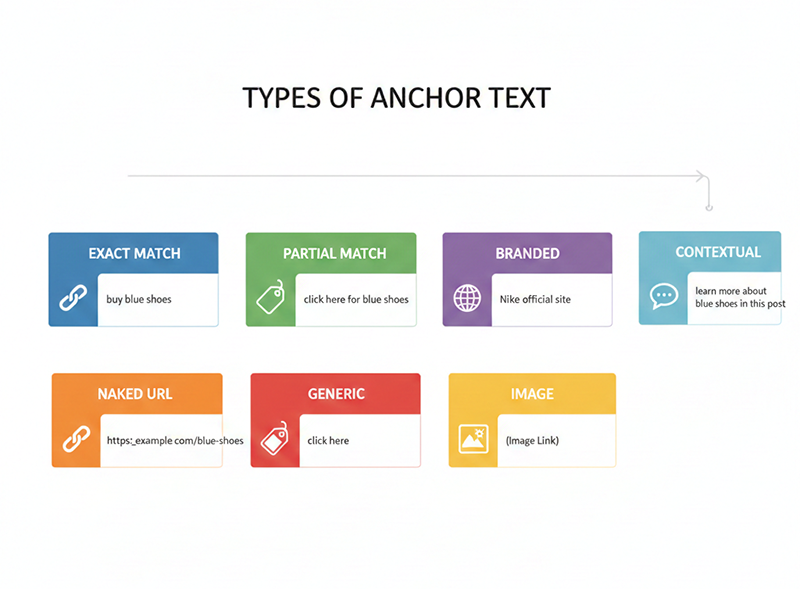
Exact match anchors use the precise keyword you want to rank for. For example, if your target phrase is “Types of Anchor Text in SEO,” an exact match anchor links that exact phrase to your page.
Benefits:
- Signals relevance strongly to search engines.
- Helps improve rankings for the exact keyword.
Risks:
- Overuse can appear manipulative and trigger penalties.
- Can look unnatural if used too frequently across a backlink profile.
Best Practices:
- Use exact match anchors sparingly—usually 10–20% of your total backlinks.
- Mix them with branded, partial match, and generic anchors to create balance.
- Use them naturally in content. For instance, you could write: “Understanding the types of anchor text in SEO is crucial for any link-building strategy.”
Exact match anchors are powerful but should always be part of a diverse strategy to avoid penalties.
Partial Match Anchors
Partial match anchors include your target keyword within a longer, natural phrase. For example: “Learn effective types of anchor text in SEO strategies for better link building.”
Advantages:
- Provides keyword relevance without over-optimization.
- Looks natural in content and user-friendly.
Tips for Using Partial Match Anchors:
- Make the sentence flow naturally.
- Avoid stuffing multiple keywords in one anchor.
- Use in blogs, guides, and guest posts where context matters.
Partial match anchors help reinforce keyword relevance while maintaining readability. They are ideal for content that educates or guides users, as they provide both clarity and SEO value.
Branded Anchors
Branded anchors use your brand name instead of a keyword. For example, simply using “VisiBlitz” as the anchor text.
Benefits:
- Enhances brand recognition.
- Signals trustworthiness to search engines.
- Natural and safe from penalties.
Best Practices:
- Pair branded anchors with exact or partial match anchors.
- Keep your brand name consistent across backlinks.
- Example: “Our platform, VisiBlitz, simplifies the process of guest posting for marketers.”
Branded anchors are particularly useful for increasing visibility, building trust, and creating a professional backlink profile.
Naked URL Anchors
Naked URL anchors are exactly what they sound like—the web address itself as the link text, such as “visiblitz.net.”
Benefits:
- Appears completely natural to users.
- Reduces risk of over-optimization.
- Works well in forums, social media, and user-generated content.
Best Practices:
- Include some naked URL anchors in your backlink profile.
- Combine with other types for a balanced strategy.
- Example: “For more information, visit visiblitz.net for tips on SEO and link building.”
Naked URL anchors may not carry as much keyword weight as exact match, but they help make your backlink profile look authentic.
Generic Anchors
Generic anchors are simple phrases like “click here” or “read more” that don’t include specific keywords. While they may seem basic, they play an important role in creating a natural-looking backlink profile. These anchors are easy for users to understand and can guide readers to related content without overloading links with keywords. In this section, we’ll explore why generic anchors matter, how to use them effectively, and how they fit into a balanced SEO strategy.
Advantages:
- Looks natural to readers.
- Helps avoid overusing keywords.
Drawbacks:
- Minimal SEO impact compared to keyword-rich anchors.
Best Practices:
- Use alongside other anchor types to maintain natural diversity.
- Example: “To explore more strategies, click here to read our guide.”
Generic anchors are overlooked by many but contribute to a realistic and safe backlink profile.
Image Anchors and Alt Attributes
When an image is linked, the alt text functions as anchor text. Since search engines cannot “see” images, they rely on the alt text to understand the link’s context.
Best Practices:
- Use descriptive alt text reflecting the page’s topic.
- Include keywords sparingly.
- Avoid keyword stuffing across multiple images.
- Example: An infographic showing backlink types could use the alt text: “Diagram illustrating the types of anchor text in SEO.”
Image anchors are particularly useful for visual-heavy content, infographics, and product pages.
Contextual and Semantic Anchors
Contextual or semantic anchors use related terms rather than the exact keyword. For example, linking phrases like “link building strategies” or “backlink optimization” when discussing anchor text.
Benefits:
- Improves topical relevance.
- Creates a natural backlink profile.
- Reduces penalty risk.
Best Practices:
- Use them to complement exact and partial match anchors.
- Ensure the anchor fits naturally into the content.
- Example: “Effective link building strategies rely on using a variety of anchor text types.”
Semantic anchors help search engines understand the overall topic and improve your content’s authority.
Anchor Text Distribution and Balance
Creating a natural and balanced anchor text profile is crucial for both SEO success and avoiding search engine penalties. It’s not just about using keywords; it’s about how often, where, and in what context each type of anchor appears. Proper distribution ensures your backlinks look organic, signals relevance to search engines, and improves user experience by providing meaningful links. In this section, we’ll break down the ideal balance between exact match, partial match, branded, naked URL, generic, and contextual anchors, showing you how to maintain diversity and build a sustainable, effective backlink strategy.
A healthy backlink profile relies on variety:
- Exact match anchors: 10–20%
- Partial match anchors: 20–30%
- Branded anchors: 30–40%
- Naked URL anchors: 10–20%
- Generic and contextual anchors: remaining percentage
Regular audits help maintain a balanced anchor distribution. Overusing a single type can look manipulative and reduce SEO performance.
Tips for balance:
- Track anchor diversity using SEO tools.
- Update old content to include varied anchors.
- Focus on natural integration within content.
Balance ensures backlinks look organic and search engines view your site as trustworthy.
Practical Tips for Using Anchor Text
Using anchor text effectively is both an art and a science. While understanding the different types of anchor text is essential, knowing how to apply them in real-world scenarios makes the difference between a strong backlink profile and one that could harm your SEO. Practical tips help you navigate common challenges, like avoiding over-optimization, improving user experience, and maintaining a natural link profile. In this section, we’ll explore actionable strategies that make your anchor text work for both search engines and your readers, ensuring every link contributes positively to your website’s performance.
- Think about the reader first: Anchor text should make sense in context and guide users naturally.
- Avoid keyword stuffing: Use exact matches sparingly.
- Mix anchor types: A mix of exact, partial, branded, generic, and naked URL anchors is best.
- Use semantic variations: Contextual anchors make content more natural.
- Monitor and audit: Regularly check your backlink profile for unnatural patterns.
Conclusion
Anchor text is more than clickable words—it’s a critical SEO signal. Understanding the types of anchor text in SEO—exact match, partial match, branded, naked URL, generic, image, and contextual—helps you create a strong, safe, and effective backlink profile.
A thoughtful anchor text strategy:
- Boosts search rankings.
- Improves user experience.
- Strengthens brand authority.
- Minimizes risk of penalties.
Used correctly, anchor text becomes a powerful tool in your SEO toolkit. A balanced, natural approach ensures long-term success and keeps both users and search engines happy.