
Choosing the Best CMS for SEO is one of the most critical decisions a business can make when launching or redesigning a website. Yet, it’s often treated as a purely technical or design-related choice. Many founders believe that as long as content is good, SEO results will follow—regardless of the CMS.
In reality, SEO performance is deeply tied to the system behind the website. The CMS defines how much control you have over technical SEO, performance optimization, and long-term scalability. That’s why selecting the Best CMS for SEO is not about trends or popularity—it’s about capability.
SEO success is not about the CMS name, it’s about how much SEO control the CMS gives you. Choosing the right CMS goes beyond design and convenience. Many businesses underestimate how technical limitations can affect search rankings and SEO KPI over time. For instance, a website may have excellent content, but if the CMS restricts URL structure or prevents proper canonical tagging, pages may never reach their full potential in search results. Understanding these constraints early ensures your website grows without hitting SEO roadblocks.
Why CMS Choice Matters for SEO
Search engines don’t rank websites based on content alone. They evaluate structure, speed, crawlability, and consistency. All of these elements are heavily influenced by your CMS.
Two websites with similar content and backlink profiles can perform very differently in search results if one CMS restricts SEO customization. This is why experienced professionals don’t ask which platform is easier to use. They ask which one is the Best CMS for SEO for their specific growth model.
When the CMS works against SEO, every optimization becomes a workaround. When it supports SEO, growth becomes systematic.
What Makes a CMS SEO-Friendly?
Not every platform that claims to be “SEO-ready” actually provides real SEO control. A truly SEO friendly CMS allows flexibility at both the technical and strategic level.
SEO Requirements a CMS Must Support
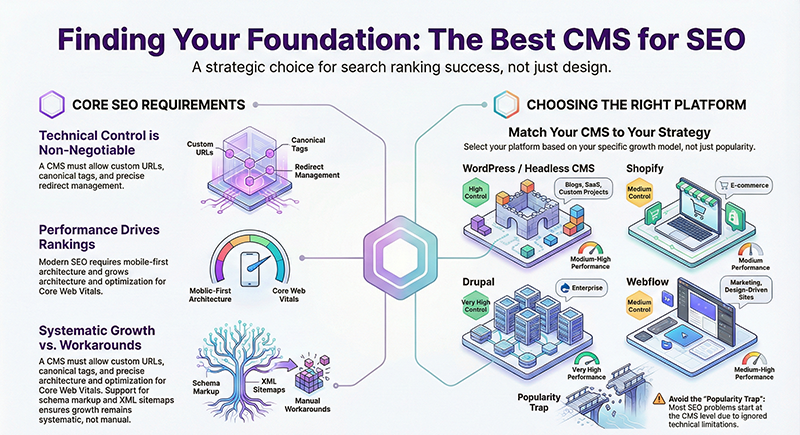
To qualify as the Best CMS for SEO, a platform must support:
- Full control over title tags and meta descriptions
- Editable, clean URL structures
- Custom canonical tags
- Proper redirect management
- Indexing control (noindex, nofollow)
- Schema markup support
- XML sitemap customization
- Strong performance and Core Web Vitals
- optimization
- Mobile-first architecture
- Scalable content organization
Without these, SEO growth eventually hits a ceiling.
Best CMS Platforms for SEO: Detailed Comparison
Instead of listing platforms, let’s analyze how they perform when SEO control is the priority.

WordPress
For many professionals, WordPress remains the benchmark when discussing the Best CMS for SEO.
- SEO Control: High
- Performance: Medium–High
- Scalability: High
WordPress offers extensive SEO flexibility, especially when paired with quality hosting and proper configuration.
For example, many WordPress sites fail to take advantage of built-in SEO capabilities simply because the default theme or plugins are not optimized. Choosing a lightweight theme and a well-coded SEO plugin can make a huge difference, helping pages load faster, improving mobile performance, and providing precise control over metadata. These adjustments are why WordPress often ranks as the Best CMS for SEO among content-heavy sites.
Why WordPress works well for SEO:
- Full metadata control
- Advanced SEO plugins
- Flexible URL structures
- Easy schema implementation
- Large SEO-focused ecosystem
However, WordPress is not inherently optimized. Poor setup decisions can quickly undermine its strengths.Many WordPress sites fail to reach their potential simply because the theme or plugins are poorly optimized. Choosing a lightweight theme and a quality SEO plugin can improve page speed, mobile performance, and metadata control, which is why WordPress is often considered the Best CMS for SEO for content-heavy sites.
Webflow
Webflow is often praised for performance, making it a strong candidate in discussions about the Best CMS for SEO from a speed-first perspective.
- SEO Control: Medium–High
- Performance: High
- Scalability: Medium
Its clean codebase and fast load times help many Webflow sites achieve excellent Core Web Vitals scores.
Strengths:
- Clean HTML output
- Strong performance
- Built-in SEO controls
Limitations:
- Less flexible for large-scale SEO
- Limited advanced customization
Webflow’s visual editor makes it easy for designers to create SEO-friendly pages without touching code, but advanced marketers might need more granular control over redirects or structured data. Despite these limits, its clean output often results in better performance scores than poorly configured WordPress installations, which is why many agencies consider it a strong contender for the Best CMS for SEO for marketing-focused websites.
Best for:
Marketing websites and brand-focused projects.

Shopify
Best CMS for E-commerce SEO
Shopify is often described as the Best CMS for SEO for e-commerce, but that description depends on expectations.
- SEO Control: Medium
- Performance: Medium
- Scalability: High
Shopify prioritizes ease of use and scalability, sometimes at the expense of deep SEO control.
Advantages:
- Stable infrastructure
- Built-in technical SEO basics
- Easy product management
Limitations:
- Restricted URL structures
- Limited canonical control
- Duplicate content challenges
Shopify is excellent for businesses that prioritize speed to market, but limitations such as automatic collection of URLs or restricted control over product canonical tags can be challenging for SEO experts. Understanding these trade-offs helps store owners implement workarounds like structured data or apps for redirects, which can improve search performance while still benefiting from Shopify’s robust infrastructure.
Best for:
E-commerce brands focused on operational simplicity.
Drupal
In enterprise environments, Drupal is frequently considered among the Best CMS for SEO solutions.
- SEO Control: High
- Performance: Medium
- Scalability: Very High
Drupal excels in complex content structures and multilingual SEO.
Drupal’s strength lies in its flexibility for enterprise-level SEO strategies, including multilingual support, complex content modeling, and precise access control. While setup requires experienced developers, the long-term benefits include scalable architecture and robust technical SEO capabilities that can accommodate millions of pages without performance loss, making it one of the strongest candidates for the Best CMS for SEO in large organizations.
Best for:
Enterprise platforms and large organizations
Headless CMS (General Overview)
For fully custom projects, many SEO specialists view headless solutions as the Best CMS for SEO overall.
- SEO Control: Very High
- Performance: Very High
- Scalability: Very High
Headless CMS platforms allow complete control over frontend performance and SEO architecture.
Headless CMS platforms provide complete freedom over how content is presented, which can optimize both speed and crawlability. Teams can implement advanced SEO strategies such as server-side rendering, custom URL structures, and modular content delivery. For businesses aiming for long-term scalability and control, these platforms are often considered the ultimate Best CMS for SEO choice.
Best for:
Custom SaaS platforms and SEO-first systems.
CMS SEO Feature Comparison
| CMS | SEO control | Performance | Scalability | Best for |
| Word Press | High | Medium_High | High | Blogs,SaaS |
| Webflow | Medium_High | High | Medium | Marketing sites |
| Shopify | Medium | Medium | High | E-commerce |
| Drupal | High | Medium | Very High | Enterprise |
| Headless CMS | Very High | Very high | Very High | Custom projects |
Best CMS for SEO by Use Case
Choosing the Right CMS
There is no single Best CMS for SEO for every business. Each website has unique goals, audience needs, and technical requirements. A small content-focused blog might perform exceptionally well on WordPress, while a large e-commerce store could benefit more from Shopify or even a headless CMS for maximum flexibility. Similarly, enterprise organizations with complex multilingual content often choose Drupal because it offers scalability and robust SEO control. Choosing the right CMS requires understanding not only the platform’s features but also your own business priorities, resources, and long-term growth plans. The best CMS is the one that aligns with your strategy and allows your SEO efforts to scale effectively.
- Content-focused sites → WordPress or Headless CMS
- Marketing sites → Webflow
- Online stores → Shopify
- Enterprise platforms → Drupal
SEO success improves when CMS choice supports long-term strategy.
Common CMS SEO Mistakes
Even with the right CMS, many websites struggle with SEO because of common mistakes. Understanding these pitfalls early can save time, prevent ranking issues, and make sure your SEO strategy works as intended. Below are the most frequent errors that businesses make when selecting or managing a CMS.
What to Avoid
- Choosing a CMS based on popularity
- Ignoring technical limitations
- Relying on plugins instead of architecture
- Sacrificing performance for visuals
- Migrating CMS without SEO planning
Most SEO problems start at the CMS level.
Final Verdict: There Is No Universal Winner
There is no universal Best CMS for SEO.
SEO doesn’t start wit keywords.Ultimately, there is no one-size-fits-all CMS. Small blogs might thrive on WordPress, large e-commerce stores on Shopify, and custom SaaS platforms on headless CMS. Considering technical resources and growth plans ensures your CMS choice supports long-term SEO success, preventing limitations as your site expands.
It starts with choosing the Best CMS for SEO.Ultimately, the best CMS is not universal; it depends on your goals, technical resources, and growth plans. A small content blog might thrive on WordPress, while a large e-commerce store may need Shopify or even a headless approach. Considering these factors before building or migrating your site prevents SEO limitations down the line, ensuring every piece of content has the chance to perform at its full potential.