
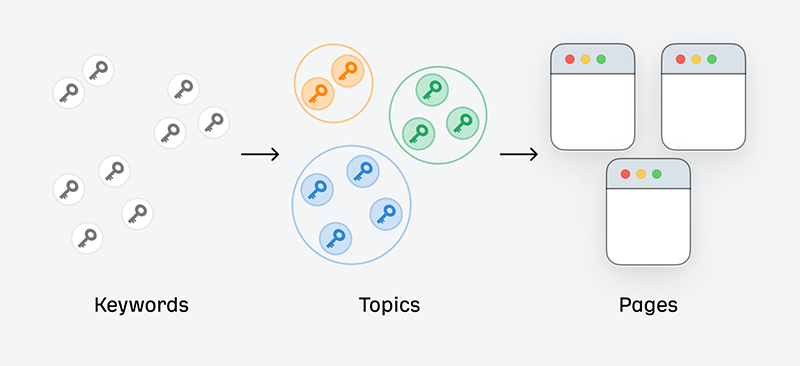
In SEO landscape, optimizing for a single keyword is no longer enough. Google has shifted toward semantic search, meaning it interprets user intent and understands the context around search queries rather than just matching exact keywords. This evolution has made keyword clustering a crucial strategy for SEO professionals, content strategists, and digital marketers. Keyword clustering allows you to organize your target keywords into meaningful groups, ensuring your content aligns with user intent, builds topical authority, and enhances your site’s overall relevance in search results.
By the end of this guide, you’ll understand what keyword clustering is, why it matters, and how to implement it effectively, from research and grouping to mapping clusters to content and using the right tools.
What is Keyword Clustering?
At its core, keyword clustering is the practice of grouping similar or related keywords into clusters based on intent, semantic relevance, and search context. Instead of treating each keyword in isolation, you create thematic groups that can guide the structure of your content strategy.
This differs from traditional keyword targeting, where content is often built around a single primary keyword, with secondary keywords sprinkled in. Keyword clustering takes a broader, more holistic approach. It ensures your content covers the topic comprehensively, increasing your chances of ranking for multiple related queries.
Example: Imagine you run a blog about running shoes. Instead of creating separate articles targeting “best running shoes 2025,” “men’s running shoes,” or “women’s trail running shoes,” you could create a keyword cluster:
- Cluster Topic: Running Shoes
- Best running shoes 2025
- Men’s running shoes
- Women’s trail running shoes
- Running shoes for flat feet
- Lightweight running shoes
By grouping these keywords, you can structure your content into a pillar page on “Running Shoes” and cluster content on each subtopic, enhancing both user experience and SEO performance.
Why Keyword Clustering Matters for SEO
Targeting single keywords is no longer enough in modern SEO. Google now values user intent and context, favoring sites that cover topics comprehensively. Keyword clustering helps you group related keywords, creating structured, interconnected content that boosts relevance and authority.
This approach improves both SEO performance and user experience, allowing visitors to find answers easily while helping search engines recognize your site as a trusted authority. In the following sections, we’ll explore how keyword clustering builds topical authority, enhances content relevance, prevents keyword cannibalization, and strengthens internal linking.
- Builds Topical Authority
By covering a topic comprehensively through clusters, you signal to Google that your site is an authority in that area. Instead of isolated pages with scattered keywords, clusters create content hubs that showcase your expertise. For example, a digital marketing website can create a cluster around “SEO” with subclusters like “on-page SEO,” “technical SEO,” and “link building.” - Improves Content Relevance and Ranking
Clustered keywords allow content to address multiple related search queries naturally. This semantic alignment ensures Google understands the full context of your content, increasing your chances of ranking for more queries and enhancing user satisfaction. - Helps Avoid Keyword Cannibalization
When multiple pages target the same keyword individually, they compete against each other, causing keyword cannibalization. Keyword clustering allows you to assign specific clusters to each page, ensuring your content complements rather than competes internally. - Enhances Internal Linking and Site Structure
Clusters make internal linking more systematic. Pillar pages link to cluster pages and vice versa, creating a logical content network. This improves crawlability for search engines and guides users through your site seamlessly.

How to Do Keyword Clustering (Step by Step)
Implementing keyword clustering involves a structured workflow that turns a long keyword list into actionable content strategy.
Step 1: Keyword Research (Collect a Master List)
Start with a comprehensive keyword list from tools like Google Keyword Planner, Ahrefs, or SEMrush. Include primary keywords, long-tail variations, and semantically related terms. Don’t filter too aggressively; having a wide pool gives you more flexibility during clustering.
Step 2: Grouping Keywords by Intent and Semantic Similarity
Sort keywords based on user intent: informational, navigational, transactional, or commercial investigation. Then, identify semantic relationships. For example, “best SEO tools” and “top keyword research tools” can fall under the same cluster, while “SEO services pricing” belongs in a different transactional cluster.
Step 3: Using Tools
Tools like Ahrefs Keyword Explorer, SEMrush Keyword Manager, Keyword Cupid, or even manual Excel methods can help automate clustering. Manual clustering works for smaller datasets, while automated tools save time for larger campaigns. Visualization tools like mind maps can help illustrate the relationships between clusters.
Step 4: Mapping Clusters to Content
Once clusters are defined, map each to your content plan. Create pillar pages for broad clusters and supporting content for each subcluster. For example, a pillar page on “Digital Marketing” can link to cluster pages like “Email Marketing Strategies,” “Social Media Analytics,” and “SEO Fundamentals.” This approach not only organizes your content but also strengthens internal linking and topical authority.
Tools for Keyword Clustering
Effective keyword clustering requires the right tools. While manual clustering is possible, specialized platforms save time, improve accuracy, and reveal semantic relationships that might be missed. Here’s a breakdown of some of the most popular tools for keyword clustering and how they can help:
- SEMrush Keyword Manager: SEMrush Keyword Manager helps you organize large keyword lists, sort by search volume, difficulty, and intent, and spot gaps in competitors’ strategies.
- Ahrefs Keyword Explorer: Ahrefs Keyword Explorer provides detailed keyword metrics, suggests related terms, and highlights “Parent Topics,” making it easier to plan pillar-and-cluster content strategies.
- Keyword Cupid: Keyword Cupid automates keyword clustering by analyzing semantic relationships and search intent. It generates visual maps of clusters, making it especially useful for large keyword datasets where manual sorting would be time-consuming.
- Surfer SEO, Cluster AI, and ChatGPT-Based Methods: AI-powered tools like Surfer SEO, Cluster AI, and ChatGPT assist in identifying patterns, suggesting keyword clusters, and proposing content structures.
- Manual vs. Automated Clustering: Manual clustering gives full control over keyword groupings but can be slow for large datasets. Automated clustering handles massive keyword lists quickly but may need refinement. A hybrid approach, starting with automated grouping and fine-tuning manually, often produces the best results.
Using these tools effectively allows you to create well-structured keyword clusters, strengthen topical authority, and improve overall SEO performance.

Keyword Clustering Best Practices
When implementing keyword clustering, keeping a clear strategy in mind ensures both SEO effectiveness and a seamless user experience. Key best practices include:
- Prioritize search intent over exact match: Focus on what users are actually looking for rather than forcing exact keywords. Group keywords based on similar user needs to make your clusters more relevant and authoritative.
- Use clusters for both on-page SEO and content strategy: Clusters should guide which topics to cover on individual pages and help structure pillar-and-supporting content. This approach ensures a logical, interconnected website that strengthens topical authority.
- Internal linking between related cluster pages: Connect cluster pages to the pillar page and to each other. This creates a clear content network that’s easy for users to navigate and for search engines to crawl, enhancing overall page authority.
- Optimize for featured snippets and semantic entities: Address specific user questions and incorporate semantically related terms. This improves relevance and increases the chances of your content being featured prominently in search results.
By following these practices, you create a well-structured content ecosystem that serves both your audience and search engines effectively.
Common Mistakes to Avoid
Even with a strong strategy, there are pitfalls to watch for when working with keyword clusters:
- Targeting too many clusters in one article: Overloading a page with multiple clusters can dilute focus and confuse readers and search engines. Focus each page on a main cluster with relevant subtopics.
- Ignoring search intent variations: Keywords that appear similar may have different user intent. Failing to differentiate can reduce relevance and ranking potential.
- Over-optimizing with keyword stuffing: Cramming clustered keywords unnaturally into content harms readability and can trigger search engine penalties. Prioritize natural integration.
- Not updating clusters as search trends evolve: Keyword trends change over time. Regularly reviewing and refreshing clusters keeps your content competitive and aligned with current search behavior.
By avoiding these common mistakes, your keyword clustering strategy remains effective, relevant, and future-proof.
Keyword Clustering and Topical Authority
Keyword clusters are central to building content hubs, which enhance your topical authority. By systematically covering all subtopics under a primary topic, you signal to Google that your site is comprehensive and authoritative.
Example: A website on “Digital Marketing” can create subclusters for:
- SEO
- Email Marketing
- Social Media Marketing
- PPC Campaigns
Each subcluster contains supporting content pages, interlinked with the main pillar page. Over time, this structure strengthens your domain authority and improves Google’s E-E-A-T (Experience, Expertise, Authoritativeness, Trustworthiness) signals.
Visualization tip: Picture your content as a tree. The pillar page is the trunk, clusters are the branches, and individual posts are the leaves. A well-structured tree supports growth, is easily navigable, and signals strength to search engines.
Conclusion & Next Steps
Keyword clustering is a critical SEO strategy for anyone aiming to improve organic visibility, topical authority, and content performance. By grouping keywords into logical clusters, mapping them to content, and optimizing internal linking, you can:
- Rank for more related queries
- Avoid keyword cannibalization
- Build stronger content hubs
- Enhance user experience
Start by reviewing your current keyword lists, identify opportunities for clustering, and plan a pillar-and-cluster content strategy. With consistent effort, keyword clustering can transform your SEO workflow, turning scattered pages into an authoritative, well-structured site. Start building your keyword clusters today to boost your rankings and authority.